
Eight priorities will set the direction for UCPH Geopolitics
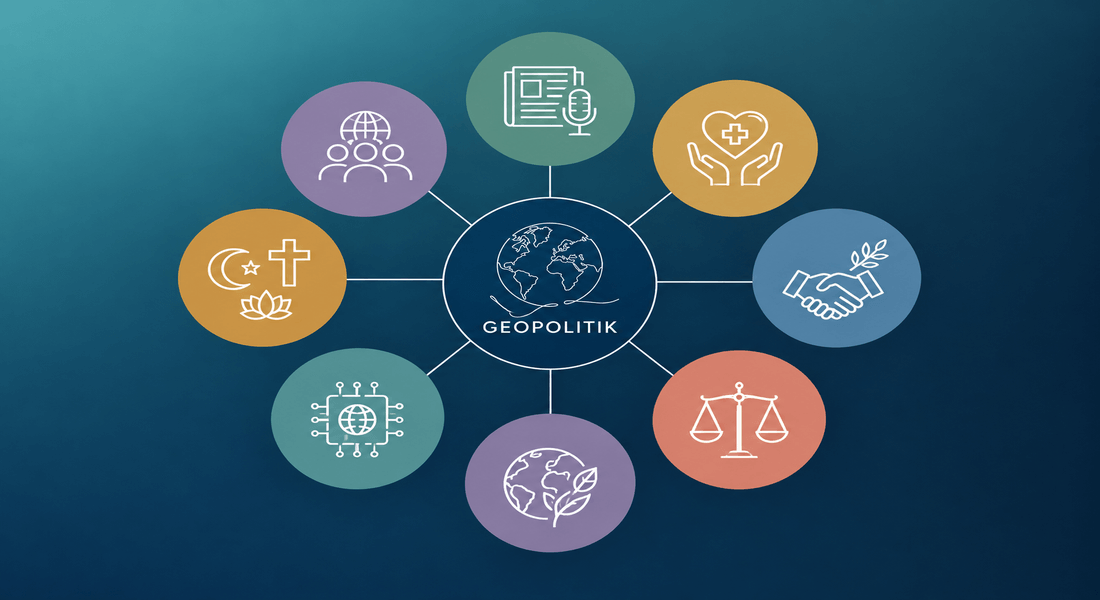
Geopolitics is a broad term. But now, KU Geopolitics is attempting to define its own scope—including what it can encompass. The steering committee has adopted eight broad geopolitical thematic priorities that it will focus on over the next three years. These thematic priorities are umbrella themes, all of which lend themselves to interdisciplinary approaches.
Each thematic priority is also led by one or more coordinators from the steering committee and encompasses various research dissemination initiatives across the university. The eight thematic priorities are stated here below.
Geopolitics, research dissemination, and the media
In an era marked by polarization, radicalization, disinformation, and AI-generated noise, the University of Copenhagen (UCPH) must play a clear role across disciplines in defending factual knowledge. This thematic priority is therefore relevant to UCPH Geopolitics’ role as a platform for research-based knowledge on geopolitics. Consequently, this thematic priority is designed to foster synergy across the entire scope of KU Geopolitics’ work—namely, the relationship between KU’s research and the outside world, the media, and public discourse.
Steering commitee contact person: Rasmus Christian Elling.
Global health, development and humanitarianism
Global health, development and humanitarian response are essential pillars of global stability and security. The erosion of health systems, development gains, and humanitarian protection can exacerbate fragility, displacement, inequality, and social unrest, creating risks that extend far beyond national borders. In addition to the expertise from global health, disaster management, and global development, the conversation would extend to political science, international relations, public health, anthropology, migration studies, Africa studies, law, economics, and climate studies.
Steering committee contact persons: Lena Skovgaard Andersen and Laura Vang Rasmussen.
Geopolitics and diplomacy
Diplomacy has been the institution and practice through which foreign politics have been conducted. Since the early 19th century, it has been professionalized, and particularly since the turn of the 20th century, following the First World War, multilateralized. At the same time, diplomacy plays a significant role in global issues such as health, climate, trade, natural resources, and the global distribution of economic power. Diplomacy is an interdisciplinary field of research that is particularly central to the social sciences and the humanities, but also to international law, international institutions, and courts.
Steering committee contact persons: Anders Wivel, Haakon A. Ikonomou and Mogens Pelt.
Religion, geopolitics, and ideologies
Religion and political ideology influence how states and movements define their interests, justify their authority, and understand their place in the world. These relationships matter for alliances and conflicts across borders. We are particularly interested in the changing relationship between religious and political institutions, but we are also interested in how local disputes become part of wider geopolitical struggles. Disputes over religious heritage, minority rights, or family and gender can bring local groups into contact with international organisations and political campaigns. The theme would connect expertise in theology and religious studies with history, political thought, area studies, political science, anthropology, and law.
Steering committee contact persons: Jan Loop and Karen Lauterbach.
International Law
The changing geopolitical landscape entails significant challenges for the role of international law – and the rule of law more broadly – as a driver for peaceful coexistence and cooperation between states. This thematic priority cuts across many disciplines as the applicable (international) legal framework is a factor in most geopolitical events and development.
Steering committee contact person: Astrid Kjeldgaard-Pedersen.
Resources and climate
More information to follow.
Geopolitics and digital infrastructure
More information to follow.
The Blind Spots of Geopolitics: Perspectives from Outside
The steering committee for UCPH Geopolitics has chosen to designate this as an open theme for sudden, emerging current issues. Researchers at UCPH are therefore encouraged to contact the steering committee with proposals and initiatives related to this thematic priority.
Steering committee contact persons: The coordinators of UCPH Geopolitics: Rasmus Christian Elling, Haakon A. Ikonomou and Katja Lindskov Jacobsen.
_______________________________________________________________
Are you a researcher employed at the University of Copenhagen, and do you have suggestions or input for initiatives under one or more of the eight themes? You are welcome to contact the Steering Group’s contact person for the relevant theme or you can contact project manager, Lise Balslev, lika@adm.ku.dk
- The Steering Committee for UCPH Geopolitics